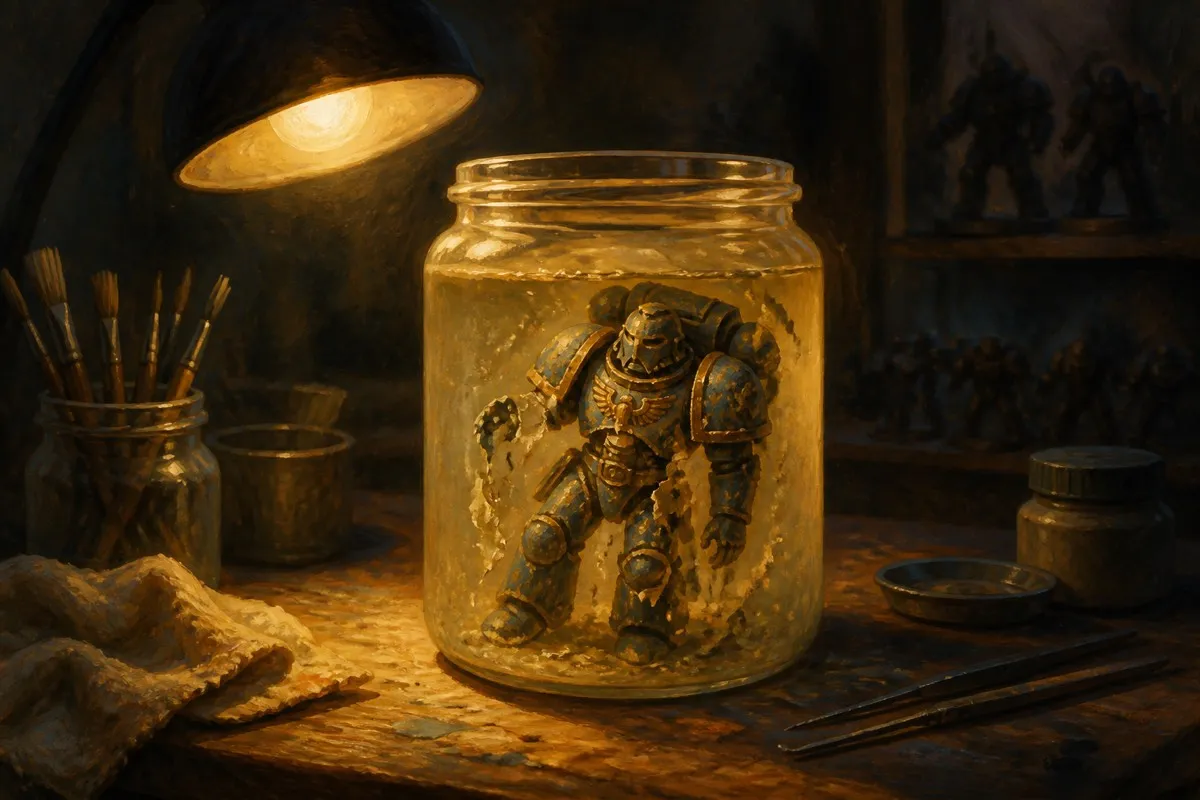
The fastest reliable way to strip paint from miniatures is a soak in a dedicated dip like Simple Green, Pine-Sol, or a purpose-made hobby stripper, followed by an old toothbrush to work the loosened paint out of recesses. Isopropyl alcohol works too and acts faster, but it is harsher on some resins and on any glued joints held with certain cements. Which one you reach for depends mostly on what the model is made of, so start there before you drop anything in a jar.
What actually dissolves acrylic paint
Acrylic paint, which is what almost every brand on the market uses, is a plastic film once it cures. It does not wash off with water and soap because water only affected it while it was wet. What strips it is a solvent that softens or breaks down that cured film without also attacking the plastic, resin, or metal underneath. Household degreasers built around butoxyethanol, isopropyl alcohol at 90 percent or higher, and dedicated hobby paint strippers all do this job. Nail polish remover with acetone will strip paint too, but acetone melts most plastic miniatures on contact, so it only belongs in a metal-only workflow.
Does the material change the method?
Yes, and this is the part painters get burned on most often. A method that is perfectly safe on metal can ruin resin, and a method that is safe on both can still be too slow to be worth using on a single test model.
| Material | Safe stripper | Soak time | What to watch for |
|---|---|---|---|
| Plastic (styrene) | Simple Green or Pine-Sol diluted | 24 to 48 hours | Check glued joints; some cements soften alongside paint |
| Resin | Simple Green or dedicated hobby stripper | 24 to 72 hours, check daily | Avoid acetone entirely; resin pits and warps easily |
| Metal (white metal or pewter) | Isopropyl alcohol or Simple Green | 1 to 24 hours | Fast paint softening; brush gently to avoid scratching detail |
| Multi-material kit | Whichever component is most sensitive | Match the resin or plastic time | Strip as one unit, do not mix chemistries on the same model |
How long should a miniature actually soak?
Set the model in a sealed jar with enough liquid to fully submerge it, then check it every few hours rather than walking away for a week. Paint that has been on a model for years, or paint applied over a heavy primer coat, takes noticeably longer than a single thin basecoat you want to redo. Pulling the model early and scrubbing with an old toothbrush under running water often finishes the job faster than waiting for the soak alone to lift everything, and it is gentler on fine details like eyes and armor trim than leaving a model to sit for days.
What household products actually work?
Simple Green is the most commonly recommended stripper because it is cheap, widely available, and safe enough on both plastic and resin when you keep soak times reasonable and rinse thoroughly afterward. Pine-Sol works on a similar principle and some painters prefer its smell over Simple Green's. Isopropyl alcohol strips faster but evaporates during long soaks, so it needs a sealed container and works best on metal models you plan to check within a few hours rather than days.
What to do once the model is bare
Rinse the model thoroughly under warm water and scrub every recess with a stiff brush to clear out any softened residue, then let it dry fully before you touch a primer to it. Any leftover stripper film left on the surface will interfere with primer adhesion and show up as patchy coverage later. Once dry, prime as you would a new model, following the same steps in our zenithal priming guide if you want to rebuild highlights fast. A liquid brush-on primer like Army Painter's Brush-On Primer is worth keeping around for stripped models specifically, since it lets you control coverage in the exact spots that lost the most detail rather than blasting the whole miniature with an aerosol, and it avoids the shipping restrictions that come with sprays. A liquid Vallejo surface primer is another option if you already run an airbrush.
If you strip a model down to test a new color scheme, this is also the moment to plan the palette before you touch a brush to it, following the same seven steps we cover for painting a miniature from scratch, since starting from a clean slate is the easiest time to fix a scheme you never liked the first time around.
For the actual bottles, both the Army Painter liquid brush-on primer(affiliate link) and the Vallejo surface primer(affiliate link) are worth having on hand before a stripping session, so a freshly bare model does not sit around collecting dust while you wait on a delivery.
FAQ
Will stripping paint damage the plastic underneath? Not if you avoid acetone and keep soak times reasonable. Plastic miniatures tolerate Simple Green and diluted isopropyl alcohol well for the soak times listed above; problems usually come from leaving a model in acetone or an unmonitored soak for days at a time.
Can I strip a painted miniature that has glued parts? Usually, but check the joints during the soak. Plastic cement welds the plastic together chemically and tends to survive most strippers, while superglue joints on resin or metal can loosen and need re-gluing after the strip.
Do I need to strip primer separately from paint? No, a proper stripping soak removes primer and paint together as one layer, since primer is also an acrylic or lacquer film once cured.
Is there a faster method than soaking? Mechanical removal with a fine wire brush works on metal miniatures without any chemical soak, but it risks scratching detail and is not recommended for plastic or resin.
What if paint will not come off certain spots? Deep recesses sometimes need a second short soak plus targeted scrubbing with a toothpick wrapped in a bit of cloth, since a toothbrush alone cannot always reach the tightest corners.