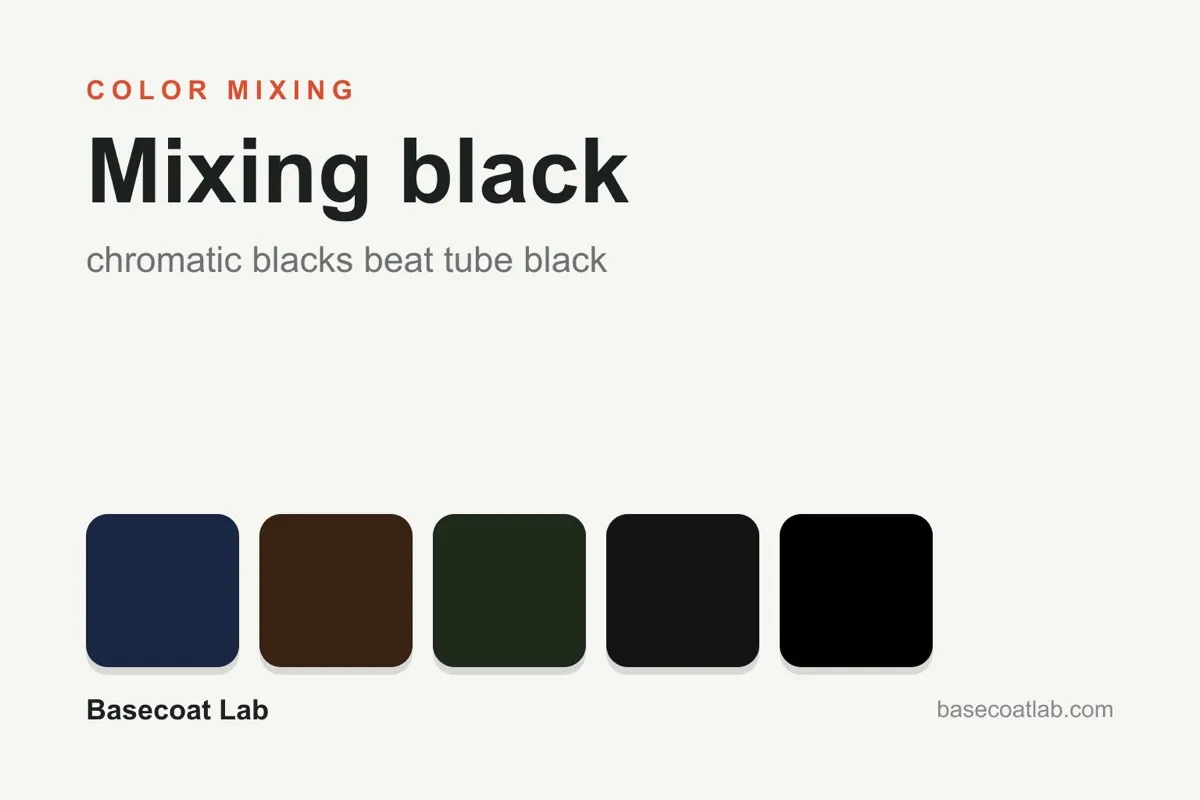
You can buy black in any paint range for a few dollars, so the real question hiding inside "what colors make black" is usually better: *should* you mix your own? Painters mix black on purpose, because a mixed "chromatic black" is livelier than the flat, light-swallowing pigment in a tube of black.
The pairs that make black
Any dark, heavily pigmented complementary pair driven to its darkest point lands at near-black:
- Ultramarine blue + burnt umber; the classic. Blue-heavy gives a cool, night-sky black; umber-heavy gives a warm, sooty black.
- Dark blue + dark red + dark green; three deep colors together cancel to black; adjusting any one of them tints the result.
- Dark green + crimson; collapses into a rich near-black with a subtle warmth that suits leather and hair.
All three routes are the same trick as mixing brown; complementary colors cancelling each other; just starting from darker parents. If your "black" keeps coming out brown instead, you have wandered into the territory covered in what colors make brown paint: your starting colors are too light or too warm.
Why bother when tube black exists
Tube black (usually carbon or mars black) is flat: it reads as a hole in the model rather than a dark surface. A chromatic black keeps a hue bias, which is what makes black *things* look real; a black cloak shaded toward blue reads cold and heavy, one shaded toward brown reads worn and warm. The practical pattern most painters land on: use tube black for priming, deep recesses, and true-black basecoats, and mix or tint blacks for everything that has to look like a material.
Steering a black
- Cool black (night, steel, modern armor): bias toward blue.
- Warm black (leather, soot, old wood): bias toward brown or crimson.
- Highlighting black: never straight grey; lighten your chromatic black with its own hue (a cold black highlights toward blue-grey, a warm one toward tan-grey).
Skip the guesswork
Whether your specific dark blue and dark brown collapse into black or stall at murky depends on the actual pigments in the bottles. The paint mixing calculator previews a digital blend of the catalog's approximate swatches; it does not measure or predict the physical pigment mixture. Test a small amount on the palette before committing. If you want a ready-made deep near-black with a hue bias, browse the Citadel paint chart darkest-first and check the covered cross-brand candidates.