Painting eyes on miniatures comes down to one dot of white and one dot of a dark color, placed with a very fine brush tip and a steady hand, not a special technique reserved for advanced painters. The reason it feels hard is scale: a 28mm face gives you a millimeter or less to work with, so the method matters more than the paint.
The basic dot method
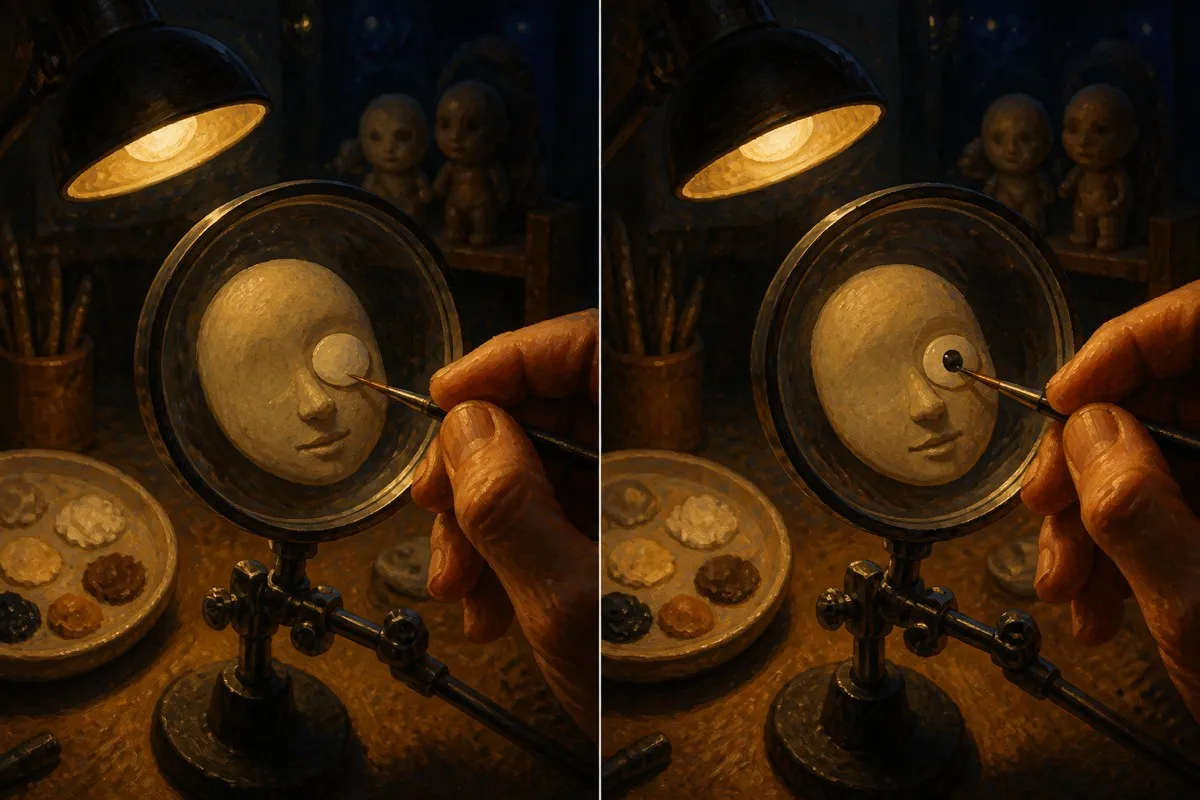
Load a fine detail brush, something like a synthetic in the size 0 to 000 range, with a small amount of paint thinned to an ink-like consistency. Touch the tip to the eye socket rather than dragging a stroke. A dab, not a brush stroke, is what keeps the shape controlled at this scale.
Start with the whole eye area in a base skin tone (see the flesh tone paint guide for options), then place a small dot of an off-white like White Scar slightly toward one side of the socket rather than dead center. Once that is dry, add a much smaller dot of a near-black like Abaddon Black on top or beside it for the pupil. The dot does not need to be a perfect circle. At tabletop viewing distance, an imperfect but well-placed dot reads correctly, while a perfectly round dot in the wrong position reads as wrong-looking eyes.
Getting the position right
The most common eye mistake is not shape, it is placement. Eyes set too high, too wide, or uneven between the two sides read as off even when each individual dot is clean. Before you touch the brush to the model, look at the sculpted eye sockets under raking light and find the actual recess the sculptor built in. Painting into that recess rather than guessing a position on flat skin gives you a natural anchor point.
For helmeted or hooded models where only a sliver of face shows, resist the urge to add full eye detail. A single dark dot in the shadow of the eye socket, without a highlight dot, often reads better than a full two-dot eye crammed into two or three square millimeters of visible face.
Steadying your hand
A shaking hand is usually a bracing problem, not a skill problem. Rest your painting hand against the table, a mahlstick, or your other hand, rather than holding the brush freehand in the air. A painting handle(affiliate link) that lets you rotate the model with your off hand while keeping your brush hand braced removes most of the wobble that ruins fine detail work, and the right detail brush holds its point far better than a worn-out one. Magnification helps as much as a steady hand does. At true 28mm scale, most painters cannot see the eye socket clearly enough to place a dot accurately without some form of magnification.
When to skip eyes entirely
On a tabletop army painted for speed rather than display, skipping individual eye dots is a legitimate choice. A dark wash into the eye socket, with no separate white or pupil dot, reads as a shadowed eye at arm's length and saves real time across a full unit. Save the full dot method for characters, single models, and anything going on a display shelf where someone will actually look that closely.
FAQ
What size brush do I need to paint eyes on miniatures?
A fine synthetic detail brush, roughly a 000 to size 1, thinned paint to a near-ink consistency, and a brush that holds a sharp point when wet matters more than the physical size number printed on the handle.
Should I paint the white dot or the pupil first?
Paint the white or off-white dot first, let it dry fully, then add the smaller dark pupil dot on top or beside it. Painting dark first makes the white harder to place accurately over it.
Why do my miniature eyes always look crossed or uneven?
Uneven placement, not shape, is almost always the cause. Check the sculpted eye sockets under angled light before painting so both dots land in the same relative position on each side of the face.
Do I need magnification to paint eyes on miniatures?
Not strictly, but most painters cannot cleanly place a dot this small without some magnification, whether a lamp with a lens, a head-mounted visor, or reading glasses stronger than your usual prescription.
Is it worth painting eyes on a full 20-plus model army?
For a tabletop army painted for volume, a shadow wash without separate dots is a reasonable tradeoff. Save full eye detail for characters and display pieces where the extra time per model pays off visually.