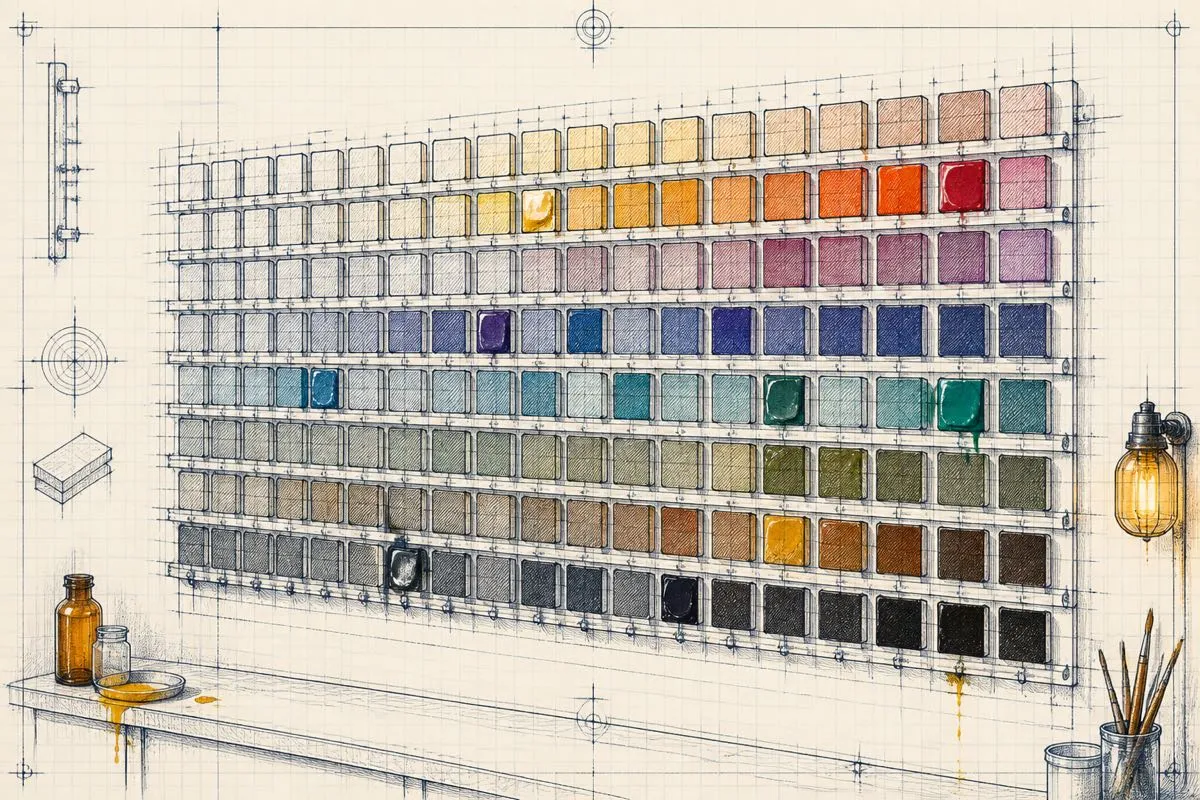
Citadel paint is Games Workshop's in-house acrylic line for Warhammer miniatures, split into six ranges that each do one job: Base for flat opaque foundation colors, Layer for building highlights on top of a base, Shade for washes that pool into recesses, Contrast for one-coat base-and-shade colors, Technical for specialty texture and effect paints, and Air for airbrush-thinned versions of core colors. Knowing which range does which job matters more than knowing individual color names, since the ranges are built to be used together in a specific order.
The six Citadel ranges at a glance
| Range | Job | When you use it |
|---|---|---|
| Base | Flat, opaque foundation color | First coat over primer |
| Layer | Lighter highlight colors | Built up over a base coat |
| Shade | Washes and glazes | Pooled into recesses after base coating |
| Contrast | One-coat base and shade combined | Fast painting over a light zenithal prime |
| Technical | Texture, rust, glow, and other effects | Specific effects, not general color |
| Air | Airbrush-thinned base colors | Airbrushing instead of hand brushing |
Base and Layer: the traditional workflow
The classic Citadel painting order is a Base coat first, applied flat and opaque over a primed model, then one or more Layer colors built up progressively lighter toward the raised edges and highlight points. This is the slowest of the Citadel workflows but gives the most control, since each layer is a deliberate decision rather than an automatic effect. Base colors are formulated to cover in one or two coats even over a contrasting primer, while Layer colors are thinner and meant to be built up gradually rather than applied full strength in one pass.
Shade: the step most painters skip too early
A Shade applied after base coating, before highlighting, pools into recesses and unifies a model's tones before you add any Layer highlights on top. Skipping straight from Base to Layer without a Shade step is the most common reason a paint job looks flat rather than dimensional. Shades are thin by design and are meant to flow into detail rather than sit on the surface like a base color.
Contrast: the fast alternative
Contrast paints combine a base color and a shade effect into a single coat, applied over a light-colored prime, usually white or grey, so the paint itself does most of the shading work as it settles into recesses and thins on raised surfaces. It is not a replacement for the full Base, Layer, Shade workflow on a centerpiece model, but it dramatically speeds up painting large units where table-ready matters more than competition-level blending. Contrast works especially well over a zenithal prime, since the primer's own light and dark gradient does extra shading work the Contrast paint reinforces.
Technical and Air: the specialists
Technical paints are not general-purpose colors at all. Each one does a specific job, texture for basing, rust and corrosion effects, glowing energy effects, and none of them substitute for a Base or Layer color. Air paints are the same core Citadel colors reformulated thinner specifically for airbrush use, useful if you already own an airbrush and want to skip manually thinning standard Base colors yourself.
What to buy first
A first Citadel purchase should cover Base, Layer, and Shade at minimum, since that trio is the actual painting workflow the other ranges support or speed up. The Citadel Colour Essentials Set(affiliate link) is built around exactly that core trio. If your priority is speed over depth, the Citadel Contrast Starter Set(affiliate link) gets full armies to a tabletop-ready standard fastest.
FAQ
What order do you paint with Citadel colors?
Prime first, then Base coat, then Shade, then Layer highlights on top. Technical effects, if used, generally come last, and Air colors replace Base coats specifically when airbrushing rather than hand brushing.
Is Citadel Contrast the same as Citadel Base paint?
No. Contrast combines a base color and a wash-like shading effect into one coat over a light prime, while Base paint is a flat opaque color applied on its own as the first coat of a traditional layered paint job.
How many Citadel paint ranges are there?
Six: Base, Layer, Shade, Contrast, Technical, and Air. Games Workshop also sells Dry and Spray ranges outside this core six.
Do I need all six Citadel ranges to start painting?
No. Base, Layer, and Shade cover the traditional workflow on their own, and Contrast alone can take a model from prime to tabletop-ready without touching the other ranges at all.
What is the difference between Citadel Air and thinning Base paint yourself?
Air paints come pre-thinned to an airbrush-ready consistency straight from the pot, while thinning Base paint yourself means adding water or a dedicated thinner and testing the ratio, which takes more trial and error to get right.