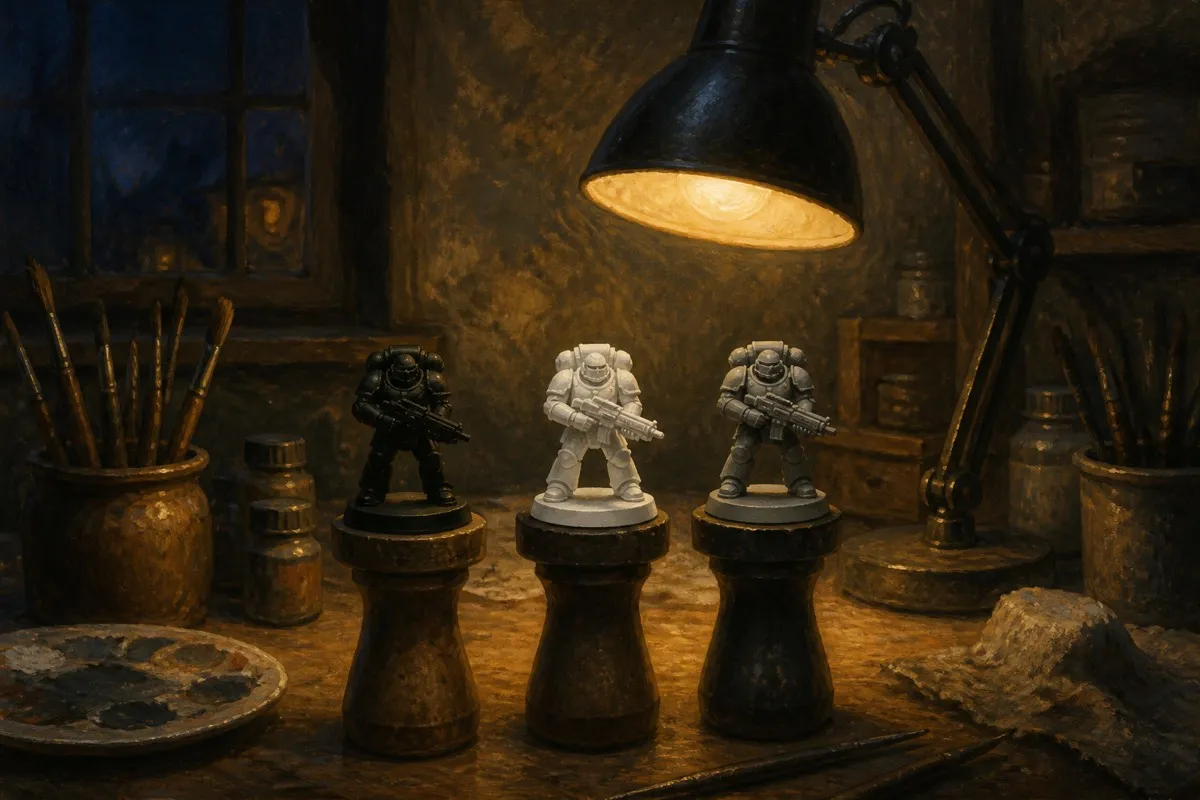
The best primer color for a miniature depends on your painting method more than the miniature itself: black primer suits dark schemes and painters who build up highlights from shadow, white primer suits bright schemes and painters who work with washes and glazes over a light base, and grey primer is the safest general-purpose default when you are not sure which of the other two fits your plan.
Black primer
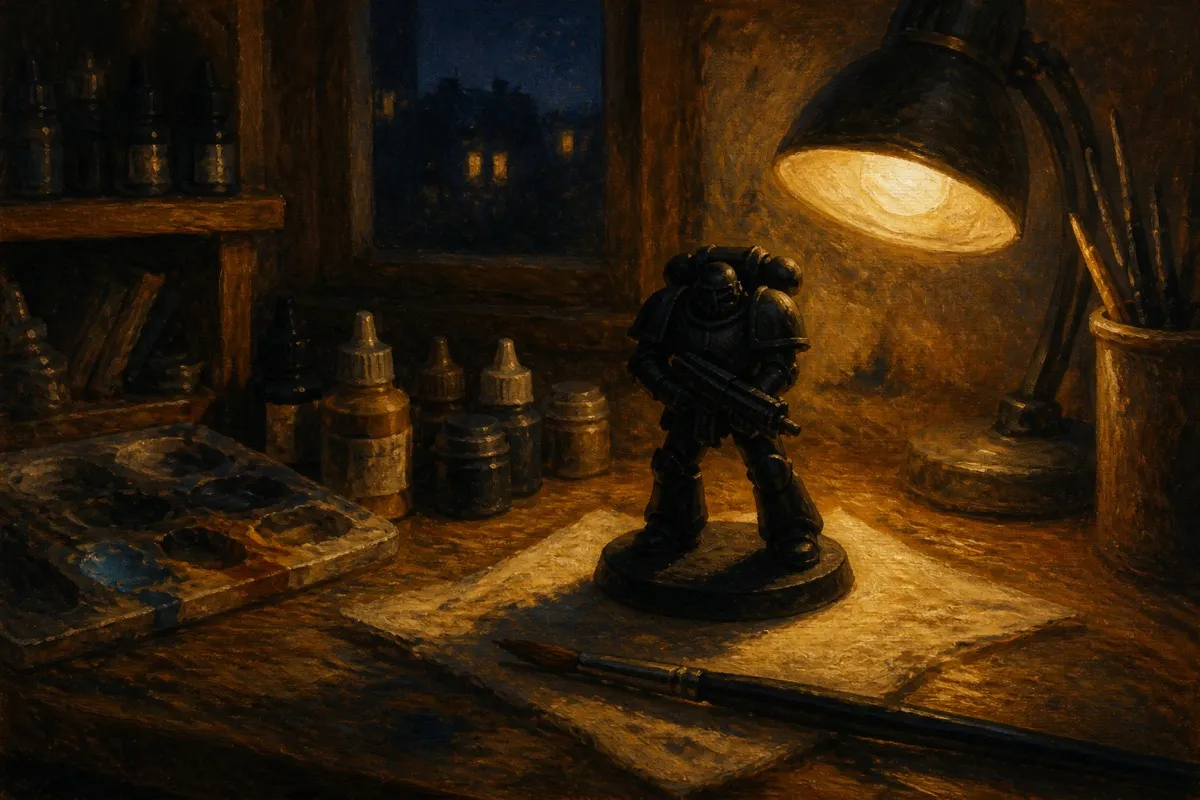
Black primer gives every recess a head start on shadow, which is useful for dark armor, gothic schemes, or any model where deep shadows are part of the intended look. Painting over black means every color you apply needs to build up toward its final brightness, since black shows through thin coats as a dulling grey rather than disappearing. This makes black primer forgiving of imperfect coverage in recesses, since any gap just reads as extra shadow, but it can make bright colors, yellows and light reds especially, take an extra coat or two to reach full saturation.
Black is also the standard base for zenithal priming, where a dark undercoat forms the shadow half of the light and dark gradient before a lighter mist is added from above.
White primer
White primer is the opposite tradeoff. Bright colors go on true to their bottle color in fewer coats, since there is no dark undertone fighting the pigment, which matters for schemes built around whites, yellows, or pale colors that would otherwise need three or four coats over black. The cost is that any thin spot or missed recess shows up as a stark white gap rather than blending into shadow, so coverage has to be more careful and complete than it does over black.
White primer also suits painters who lean on washes and glazes as their main shading tool, since a light undercoat lets a wash's own color and transparency do more of the visible work.
Grey primer
Grey primer splits the difference and is the closest thing to a genuinely safe default. It shows gaps less harshly than white while still letting colors read closer to true than black does, which makes it forgiving for painters who have not settled on one method yet or who are working across a mixed collection of light and dark schemes. Most painters who standardize on one primer color for general use land on grey for exactly this reason, keeping black or white in reserve for models where the scheme specifically calls for it.
| Primer color | Best for | Tradeoff |
|---|---|---|
| Black | Dark or gothic schemes, zenithal shadow base | Bright colors need extra coats |
| White | Bright or pale schemes, wash and glaze heavy work | Gaps and thin spots show clearly |
| Grey | General purpose, mixed collections | Not optimal for either extreme, but forgiving overall |
Picking liquid primer for the job
This site defaults to liquid primers over aerosol cans, since liquid primers can be applied by brush or airbrush without the shipping restrictions that come with aerosol sprays, and give more control over thin, even coverage either way. Pro Acryl covers all three colors from one brand, Matte Black Primer, Matte White Primer, and Matte Grey Primer, sold as a Pro Acryl primer set(affiliate link). Vallejo Surface Primer(affiliate link) is a common airbrush-friendly alternative if you are already working in Vallejo for your base coats.
If you already use Pro Acryl paints, its primer line is formulated to sit under its own base colors without extra thinning, which is a reasonable default if you want one brand's system from primer through topcoat.
FAQ
Does primer color actually change the final paint job?
Yes, especially for thin or translucent paint layers. A dark primer under a light color mutes and greys it slightly compared to the same color over a light primer, which is exactly why the choice matters for the specific scheme you are painting.
Can I switch primer colors partway through a model?
Not cleanly. Once a model is primed, changing the undertone means stripping and repriming, which is time consuming. Decide the primer color based on the finished scheme before you start, not partway through.
Is grey primer always the right choice for beginners?
It is a reasonable safe default while you are still learning how primer color affects your specific paints, since it forgives both thin and heavy coverage better than black or white do at the extremes. Once you know your usual scheme colors, switching to black or white for those specific schemes can save coats.
Do contrast and speedpaint style paints need a specific primer color?
Most contrast and speedpaint style paints are designed to be used over white, grey, or a zenithal gradient, since their shading effect depends on light showing through in the recesses less and off raised areas more. Check the specific paint line's guidance, but white or light grey is the more common starting point for these formulas.