
Useful model paint matching combines a repeatable comparison of approximate digital swatches with an awareness of finish type. A candidate that is close in the calculation but wrong in finish, a metallic paired with a flat base, or a wash paired with an opaque, can fail on the model even if the numbers look strong. Reliable matching needs both the math and the context, followed by a test of the actual paint.
What makes a matching method trustworthy
A paint matching method earns trust when it is consistent, checkable, and honest about its limits. Consistent means the same input always produces the same output, not a hand-picked answer that shifts depending on who wrote the chart. Checkable means you can see the underlying numbers, not just a verdict. Honest means it tells you when a match is weak instead of dressing up a poor result as a swap.
| Quality | Why it matters |
|---|---|
| Repeatable distance calculation | Applies the same formula to every stored digital swatch |
| Finish awareness | Stops a metallic being matched to a flat, or a wash to a base |
| Visible ranking score | Shows how the stored digital swatches compare under the site's formula |
| Transparent method | You can tell hex-based math from a community guess |
Color math versus eyeballing
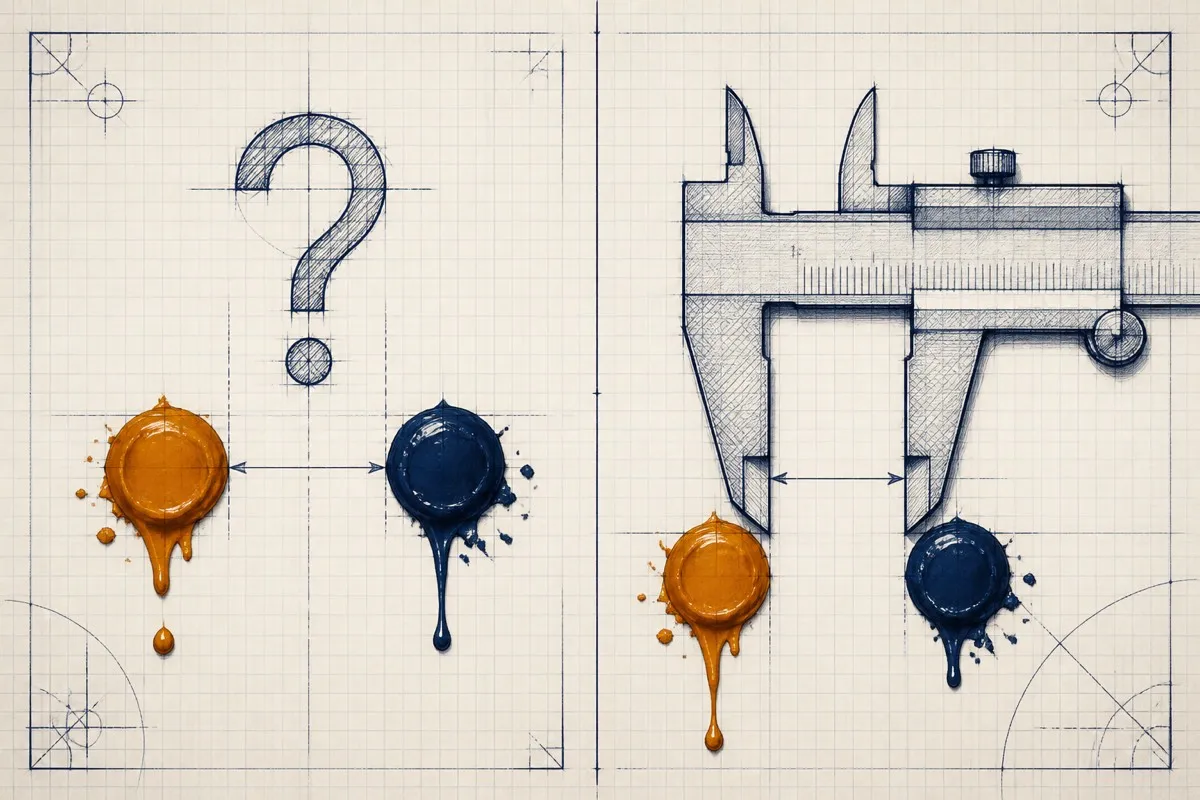
Eyeballing a match against a printed chart is fast but inconsistent. Lighting, monitor calibration, and fading can all shift what looks close. Basecoat Lab converts each stored sRGB swatch into CIE Lab and calculates CIEDE2000 distance, giving the same result whenever the same two stored values are compared. The calculation is repeatable, but the underlying swatches are approximate digital references and can inherit source and screen errors. The full method is broken down in how the matching math works.
Where matching still needs a human check
A digital color-distance calculation cannot see finish, opacity, or how a paint behaves wet on a brush. A high similarity percentage between a metallic and a matte base is a coincidence, not a usable match. That is why the best matching approach groups by finish type first, flags any match that crosses finish classes, and never presents a cross-finish result as a straight substitute. Before you buy based on a match, look at the swatches side by side on the relevant paint page and confirm the finish type lines up with what you actually need.
How to use a matching tool well
Start at the converter and pick the paint you already own or the color you are trying to hit. Read the similarity percentage as a ranking of stored swatches, not a physical-accuracy promise. Use the top same-finish results as candidates, then check the actual paints before committing to a purchase or adjusting a mixture.
Reading a real example
Take Citadel's Mephiston Red. Run it through the converter and Pro Acryl's Bold Pyrrole Red appears at 91 percent similarity, with both classed as base colors. That makes it a candidate to test, not proof of a direct physical swap. Further down the ranked list, a metallic or technical paint may share a similar stored hue but be flagged as a cross-finish result. That is the matching method working as intended: digital color first, finish context second, and an actual paint test before substitution.
Signs a matching method is not trustworthy
Be cautious of any tool or chart that gives you exactly one suggestion per paint with no percentage, no way to see runner-up options, and no explanation of finish. A single unscored answer asks you to take it on faith. It might be right, but you have no way to judge how right, and no way to tell a strong match from a weak one dressed up the same way.
FAQ
What is the most accurate way to match miniature paint colors?
A CIEDE2000 calculation applies one repeatable method to the stored swatches, while finish type supplies necessary context. It does not remove errors already present in approximate source values or predict the dried physical paint.
Can two paints have the same color and still not be a good swap?
Yes. Stored swatches for a metallic and a matte paint can calculate as close while the physical paints look and behave differently once applied, because color math cannot see shine or opacity.
Is a 100 percent match always a perfect substitute?
A very high percentage means the stored digital swatches are close under this site's formula. It does not establish that the physical paints are indistinguishable or guarantee coverage, thinning behavior, sheen, or drying time.
Do free online paint matching tools use real color math?
Some do and some just group paints by eye. Look for one that shows a numeric similarity score and explains its method, rather than one that just lists a single suggested swap with no way to check it.