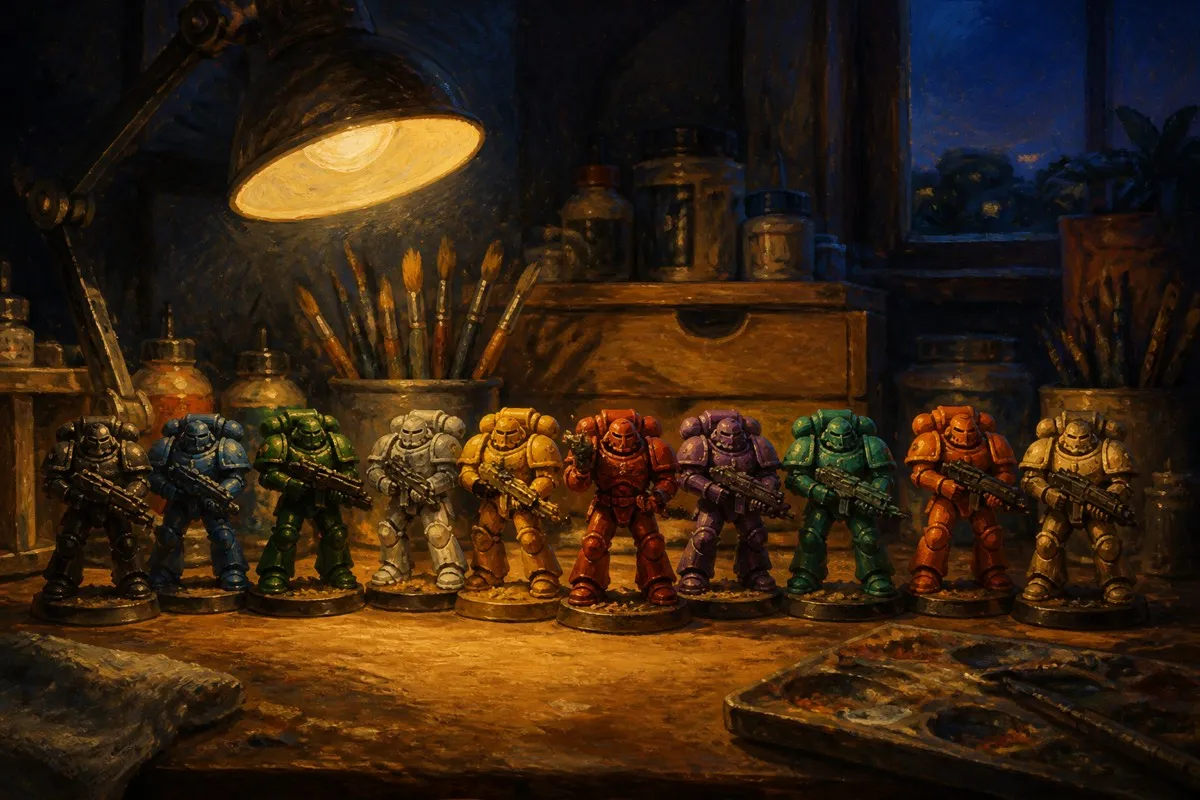
A Warhammer faction paint scheme is really just a small, repeated color palette applied consistently across every model in an army, and most factions have a canonical color or two that reads as that faction from across the table. Dark Angels are the deep green of the Dark Angels Green contrast paint, Blood Angels are the near-crimson of Blood Angels Red, and once you know the anchor color for a faction, the rest of the scheme is built around metallics, trim, and basing choices that support it rather than compete with it.
Why contrast paints changed faction painting
Before one-coat contrast paints existed, getting a consistent faction green or red across dozens of models meant base coating, then washing, then highlighting every single one, a process that could take longer than assembling the army in the first place. Contrast paints like Dark Angels Green and Blood Angels Red collapse that into a single coat over a light undercoat, since the formula self-shades into recesses and lightens on raised detail as it dries. This is the biggest reason batch-painted armies became realistic for hobbyists without dedicated studio time, and it is why most current faction guides lead with a contrast color rather than a traditional base and wash combination.
Dark Angels green
The canonical Dark Angels scheme starts with Dark Angels Green over a white or light grey undercoat, which lets the contrast formula self-shade the armor plating in one pass. Painters chasing a more traditional finish instead base with a mid-tone green, wash to deepen recesses, then highlight edges by hand, which takes longer but gives more control over exactly where the light and dark areas fall. Either route typically finishes with a metallic trim, commonly a steel or bronze from the Citadel metallic range, and a bone or parchment color for robes and detailing.
Blood Angels red
Blood Angels lean on Blood Angels Red the same way Dark Angels lean on their green, applied as a contrast coat over a light undercoat for a fast, consistent crimson across an army. A traditional approach instead builds up from Mephiston Red as the base coat, with a red wash to deepen recesses and a brighter red or orange edge highlight for a more painterly finish. Gold trim is the near-universal pairing for Blood Angels, which is why a warm gold like Retributor Armour shows up in almost every Blood Angels scheme regardless of which red approach a painter takes.
Chaos factions
Chaos armies do not share one anchor color the way loyalist Space Marine chapters do, since the aesthetic leans toward corruption and variation rather than uniformity. Dark, desaturated base colors like Rhinox Hide or near-black tones such as Abaddon Black are common starting points, heavily washed with Nuln Oil or Agrax Earthshade to push a grimy, worn look, then accented with corroded metallics and small pops of a bright, unnatural color like a chaos icon or glowing rune.
40k Ork paint
Ork skin is the defining color choice for any Ork army, and most schemes lean on a saturated green like Waaagh! Flesh or a brighter mid-tone green such as Skarsnik Green for the skin itself. Ork gear tends toward scrap-built, mismatched metal, so painters typically mix two or three metallics from the Citadel range, most often Leadbelcher alongside a rust or bronze tone, to sell the improvised, patched-together look that defines the faction visually.
Adeptus Mechanicus paint
Adeptus Mechanicus schemes are built around rust and worn red robes over exposed brass and copper mechanical parts. Martian Ironearth and Martian Ironcrust are technical paints made specifically for this faction, applying a textured rust finish directly onto exposed metal areas without needing a separate weathering step. Robes are typically a deep, worn red or rust orange, with brass or copper metallics for exposed mechanical joints and cabling.
A general approach for building any faction scheme
Pick one anchor color for the largest surface area on the model, usually armor or robes. Choose one metallic family, steel, bronze, or gold, and stay consistent with it across the whole army rather than mixing all three. Reserve a single accent color, often used only on a small detail like an eye lens, icon, or weapon glow, to draw the eye without competing with the main scheme. This three-part structure, anchor color, metallic family, single accent, holds up across nearly every faction in the game and is the fastest way to make a new army look cohesive from the first model painted.
Batch painting a full army through this process goes faster with the right brush for the job. The Citadel Base, Layer and Shade Brush Trio(affiliate link) is built around exactly this three-stage workflow, matched to base coating, layering, and washing in turn.
FAQ
What Citadel paint is used for Dark Angels green?
Dark Angels Green, a one-coat contrast paint, is the standard modern choice, applied over a light undercoat. A traditional base-and-wash approach uses a mid-tone green base with a green wash for recesses.
What color is Blood Angels red?
Blood Angels Red, a contrast paint, gives the classic crimson in one coat. Painters using a traditional method typically start with Mephiston Red as a base coat instead.
How do you paint Ork skin?
Most Ork schemes use a saturated green like Waaagh! Flesh or a brighter tone like Skarsnik Green for skin, paired with mismatched metallics for scrap-built gear and weapons.
What paints work for Adeptus Mechanicus rust effects?
Citadel's Martian Ironearth and Martian Ironcrust technical paints are built specifically for rust texture on Adeptus Mechanicus models, applying directly onto exposed metal areas.
Do Chaos armies have one standard color scheme?
No. Chaos factions typically vary scheme to scheme, but most lean on dark, desaturated base colors, heavy washing for a worn look, and small accents of an unnatural bright color rather than a single uniform palette.