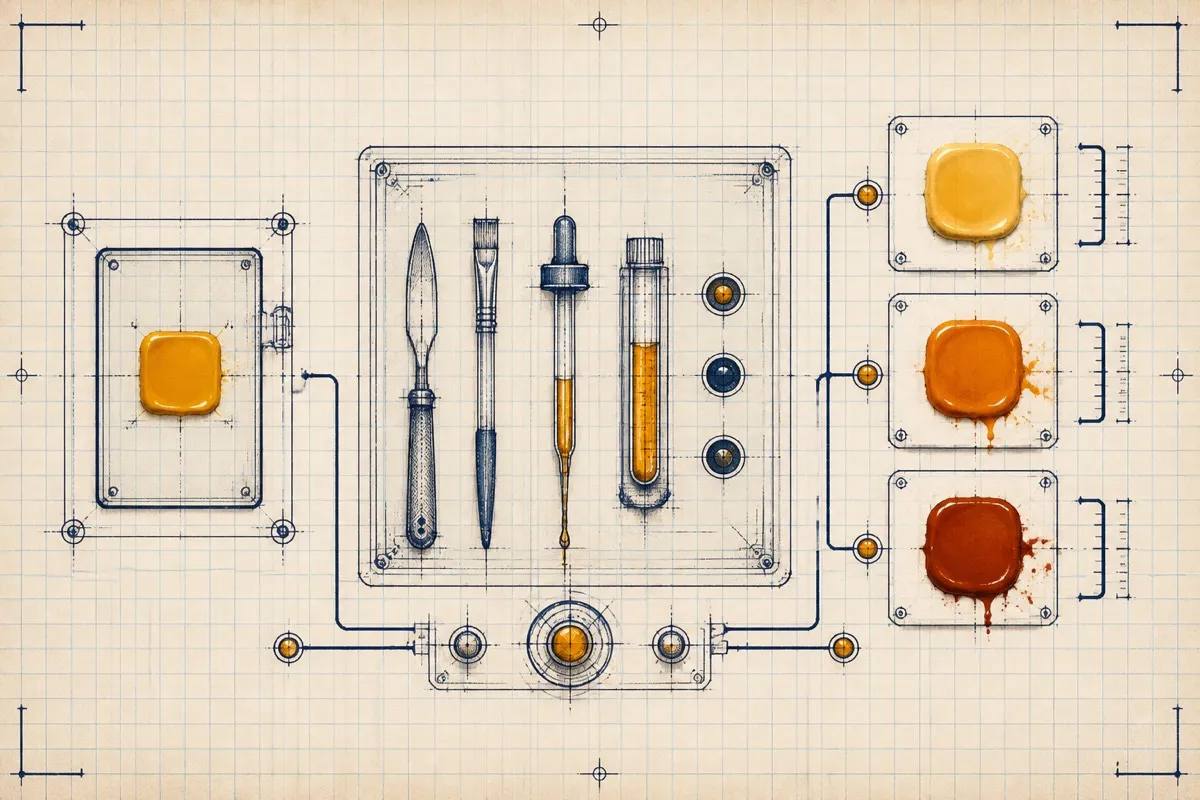
A free paint matching tool takes a color from one miniature paint brand and shows you candidate colors in other brands. This helps you shortlist a substitute, compare ranges, or find paints for a color sampled from a photo. It cannot identify the actual paint used in a photo. Useful tools disclose how they compare color references and group results by finish type so a wash never gets treated as an opaque base simply because the digital colors are close.
What a good matching tool should actually show
Color alone is not enough. A useful match needs three things: a similarity score based on real color distance rather than a vague "close" label; the finish type of both paints, since a metallic and a flat color can share a similar hue and still behave completely differently on a model; and enough matches per color so you are not stuck with one option if it turns out to be the wrong finish for your use.
The converter on this site works from approximate stored hex references, converts them to CIE Lab, and calculates CIEDE2000 distance before separating results by finish class. The catalog values come from community sources and product images; they are not measurements of physical paint. Pick a covered paint record to see ranked candidates from the covered brands, with the percentage and catalog finish type visible before you test a substitution.
How to use a matching tool correctly
Start with the paint you have in hand or the paint named in a scheme you are trying to replicate. Look up its closest candidates and check the finish type on each result. A high score in the wrong finish class still identifies the wrong kind of product. A score in the seventies means the stored digital swatches are farther apart under the site's formula, but it does not prove how the physical paints will look side by side. Test the actual paint at any score before relying on a substitution or mixture.
| Step | What to check | Why it matters |
|---|---|---|
| Pick the source paint | Confirm the exact name, not a similar-sounding one | Ranges reuse similar names across product lines |
| Read the similarity score | Higher scores mean closer stored digital coordinates | Every candidate still needs a finish check; test actual paint when accuracy matters |
| Check finish type | Base, layer, wash, metallic, and so on must match | Color alone ignores opacity and sheen |
| Confirm on the model | Dry paint over your actual primer, not the bottle | Primer and lighting shift the final read |
When a matching tool will not give you a perfect answer
No matching tool, free or paid, replaces a side by side comparison on an actual model. Two ranges are mixed independently by different manufacturers, so even a very close match can dry slightly differently depending on the primer underneath and the lighting you are painting under. Washes and one-coat style paints are the hardest category to match reliably, since their finish depends on the medium as much as the pigment, so treat any wash match as a starting point to test on a spare model rather than a guaranteed swap.
For a full brand-to-brand reference rather than looking up one paint at a time, the Citadel to Vallejo conversion chart and the other pairwise charts on this site lay out every match for an entire range at once.
FAQ
Is there really a free way to match miniature paint colors across brands?
Yes. The converter on this site calculates matches from approximate digital references and does not require payment or an account. Use its results to shortlist candidates, then test actual paint before relying on a substitution.
Do I need to know a paint's exact name to use a matching tool?
Yes, matching works from a specific paint entry, not a general description like "dark green." If you are unsure of the exact name, checking a brand's range page first helps narrow it down.
Can a matching tool tell me if a paint is discontinued?
A good one should flag current versus older status where that data is available, though the primary job of a matching tool is the color and finish match itself.
Why do two matching tools sometimes disagree on the best match?
Different tools use different color models and formulas, and some rely on community consensus rather than calculations on stored hex values. Either approach can produce a different top candidate for the same paint, so the method and source data matter.