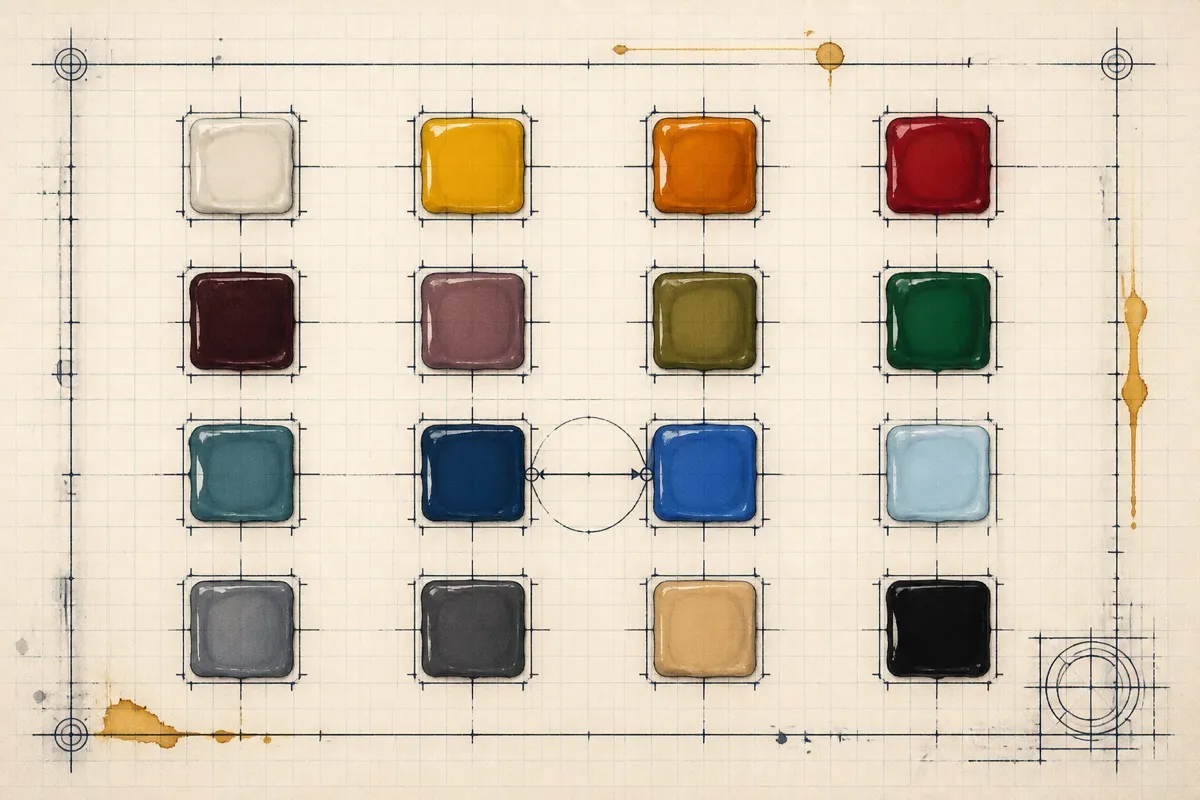
A Citadel conversion chart maps covered Citadel records to candidates in another brand. There is no single official Citadel conversion chart from Games Workshop itself, and third-party charts can disagree because their source data and methods differ. Basecoat Lab compares approximate stored digital swatches rather than physically measuring each paint. This guide explains how the matching works; if you just want candidates, the live Citadel paint conversion chart on our homepage covers 12 brands and shows calculated scores for returned results.
Games Workshop does not publish a first-party app or chart for converting its colors to other brands, which is why "citadel paint app" and "citadel color chart" are such common searches. Painters who own paints across brands need a working answer, and there is not an official one.
How does a conversion chart actually get built?
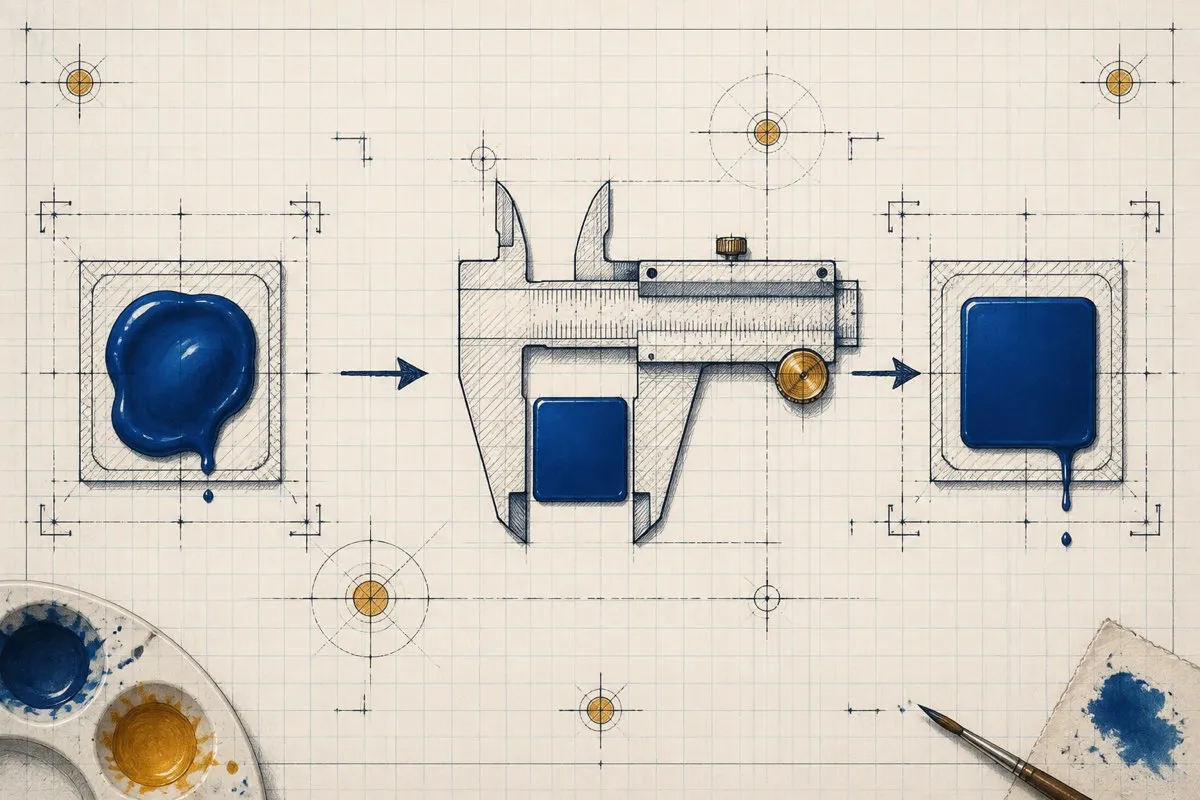
This site's repeatable method is color-distance math: convert each stored sRGB swatch to CIE Lab and calculate how far apart the two coordinates are with CIEDE2000. The source values are approximate digital references assembled from community catalogs and product images, not physical measurements supplied by every brand. A small distance ranks the stored swatches as close, while finish and an actual paint test determine whether the candidate works in practice.
Example matches from the chart
| Citadel paint | Closest match | Similarity |
|---|---|---|
| Abaddon Black | Vallejo Black (72.051) | 100 percent |
| Macragge Blue | Vallejo Magic Blue | 97 percent |
| Mephiston Red | Vallejo Carmine Red | 79 percent |
| Mournfang Brown | Vallejo Gory Red | 73 percent |
| Ushabti Bone | Vallejo Pastel Green | 66 percent |
That last row is the important lesson in this table. Ushabti Bone and Vallejo Pastel Green are the closest numeric match in the catalog, at 66 percent, which is a meaningfully weaker match than the top rows. A low percentage is the chart telling you honestly that no great substitute exists, not a hidden error.
Why does percentage match go down for some colors?
Because catalogs are not built to mirror each other. Citadel and Vallejo were developed independently with different pigment sets, so some colors have a near-perfect twin in the other brand and others simply do not. A conversion chart should show you the honest distance, not force a match that isn't really there.
Does a color chart account for finish type?
A raw color chart, on its own, does not. The color-distance calculation compares stored coordinates. It has no way of knowing that one paint is a flat opaque base and the other is a metallic, wash, or contrast paint, three finish types that behave differently on a model even when their digital references are close. That is why this conversion chart groups matches by finish class and flags cross-finish pairings instead of presenting every high score as a safe swap. A wash paired with an opaque base coat might score well numerically and still be the wrong product in practice.
Where to find the full interactive chart
The paint converter compares records across the 12 covered brands and lets you search by paint name instead of scanning a static table. The dedicated Citadel to Vallejo and Citadel to Army Painter pages provide brand-to-brand views of the curated data, and the companion guide on how conversion actually works explains why finish metadata matters alongside digital color.
FAQ
Is there an official Citadel paint conversion app?
No. Games Workshop does not publish an official cross-brand conversion app or chart. Third-party tools, including this site, fill that gap using independently computed color matching.
How accurate is a color-distance conversion chart?
It is a consistent measure of distance between the stored digital swatches. That is useful for ranking candidates, but it does not establish physical color accuracy or account for finish type, so a wash and an opaque base can score closely while behaving completely differently on the model.
Can I convert Citadel paints to more than one brand at once?
Yes. Every brand pair in the catalog has its own conversion page, so you can look up Citadel to Vallejo, Citadel to Army Painter, or any other combination the site supports.
Why do some Citadel paints have a much weaker match than others?
Because the two catalogs were not designed to line up. Some colors happen to overlap closely, others do not have a real equivalent in the second brand, and a low percentage is the honest answer rather than a flaw in the chart.
Does a 100 percent match mean the paints are identical?
It means the two stored digital swatches have the same coordinates under this site's calculation. It does not establish that the physical paints are identical or guarantee opacity, drying time, sheen, or finish.