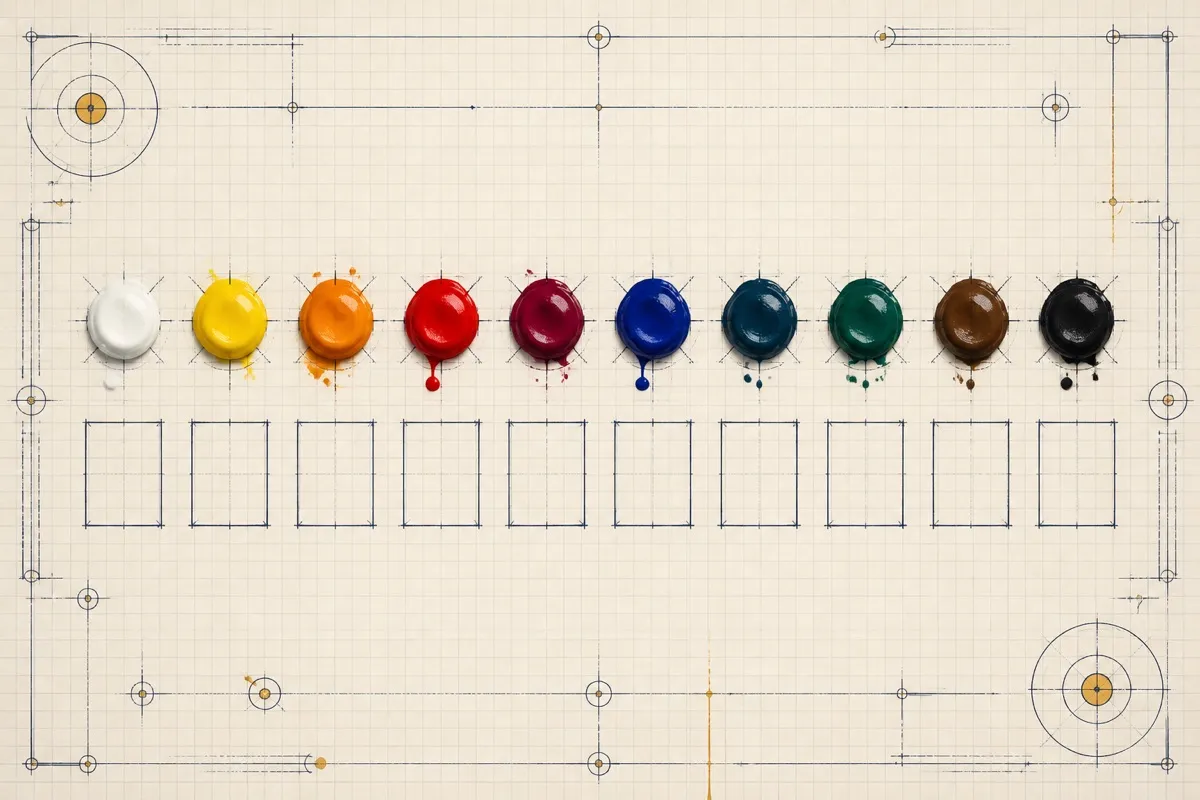
If you only buy ten Citadel Base colors, these are the ten that get you through the most factions and schemes without a special order. Base paints are built to cover in one or two coats over primer, which is the whole reason to reach for this range first: they are the workhorse layer everything else gets built on.
The list below leans toward colors that either anchor a specific well-known scheme or work as a flexible starting point you will reuse across multiple projects, rather than niche shades you would only need once.
Which base colors should a new painter buy first?

[Incubi Darkness](/paint/citadel-incubi-darkness). A near-black teal that reads as black from tabletop distance but has more depth up close, useful anywhere a scheme calls for black armor without going flat.
[Caliban Green](/paint/citadel-caliban-green). The standard dark green base for Dark Angels and any forest-camo or dark green scheme, easy to highlight up through lighter greens.
[Macragge Blue](/paint/citadel-macragge-blue). The Ultramarines blue and a genuinely flexible mid-blue base for anything from space marines to vehicles.
[Mephiston Red](/paint/citadel-mephiston-red). A saturated true red that covers cleanly in two coats, the go-to base for Blood Angels and any red-armored faction.
[Khorne Red](/paint/citadel-khorne-red). A darker, more brown-leaning red than Mephiston Red, useful when a scheme wants red without looking bright or heroic.
[Averland Sunset](/paint/citadel-averland-sunset). The standard yellow base, notoriously patchy from some manufacturers but Citadel's version covers well in thin coats, essential for Imperial Fists and any yellow scheme.
[Kantor Blue](/paint/citadel-kantor-blue). A deep navy that reads almost black in shadow, good for dark naval or void-themed schemes that want more color than straight black.
[Wraithbone](/paint/citadel-wraithbone). The pale warm grey that doubles as a base for painting and as a Contrast-paint foundation, covered in more depth in our fast-army Contrast guide.
[Evil Sunz Scarlet](/paint/citadel-evil-sunz-scarlet). Technically a Citadel Layer color rather than a Base, but it is applied as a basecoat so often for Orks and racing-red schemes that it belongs on this list functionally.
[Stegadon Scale Green](/paint/citadel-stegadon-scale-green). A muted olive green that works for reptilian skin, camouflage, and jade-toned armor alike, one of the more versatile greens in the range.
Why start with base colors instead of layer colors?
Base paints are formulated to cover primer in one or two coats, where Layer paints are thinner and built for building up highlights over an existing base. Buying base colors first gets a model to a presentable tabletop state fastest; layers, washes, and Contrast come in after that foundation is down.
That order also matters for how far a single pot goes. A base color applied at full opacity uses more paint per coat than a thin layer glaze, but it only needs one or two passes, where a highlight color might get built up in three or four thin layers across a large batch of models. Painting an entire army in base colors first, then coming back with washes and a handful of layer highlights, is generally faster than trying to fully finish one model at a time.
For the full current lineup with swatches and hex values, see the Citadel Base range page. If you are cross-shopping brands, the converter will show you the closest match in Vallejo, Army Painter, or another range for any of these ten. Once the rack grows past a handful of pots, a wall mounted paint rack(affiliate link) sized for Citadel's pot format keeps them upright and visible instead of buried in a drawer.
FAQ
Do I need all 10 of these to start painting?
No. Pick the three or four that match your first project's scheme and build the rack out from there as new projects need new colors.
What is the difference between a Base color and a Layer color?
Base colors are thicker and cover primer in fewer coats. Layer colors are thinner and meant to be built up in stages over a base coat to create highlights.
Is Wraithbone a good first purchase for a new painter?
Yes, especially if you plan to use Contrast paints, since Wraithbone is the standard pale foundation most Contrast schemes are built on.
Can these base colors be swapped for another brand's equivalents?
Generally yes by color and finish type. Check the specific paint's equivalents through the converter before assuming a one-to-one swap, since opacity and coverage can differ between brands even at a close color match.
Why is Evil Sunz Scarlet on a base color list if it's a Layer paint?
Because in practice many painters use it as their primary basecoat for red schemes despite its official range classification, and it is worth knowing that going in.